Post-Repair Equipment Inspection: What to Check Before Return to Service
5
min read


A Visual Language Model (VLM) is an AI model that can understand images, video, and language together.
In simple terms, a VLM allows AI to “look” at visual information, understand what it is seeing, and connect that visual context to language. That means a VLM can process inputs like images, video, and text, then answer questions, describe what is happening, identify objects, or reason about what appears in a visual scene.
IBM describes Vision Language Models as AI models that blend computer vision and natural language processing, allowing them to map relationships between text and visual data, such as images or videos.
For a business audience, the important idea is simple:
VLMs help AI understand visual work and explain what’s happening in useful language.
This matters because frontline work is not just text-based. It’s visual, physical, and constantly changing. A worker may be assembling an order, inspecting equipment, loading a shipment, checking safety requirements, performing a field repair, or following a sequence of steps in a busy environment. Much of that work happens through what the worker sees and does.
VLMs create a bridge between what’s visible and actionable.
Traditional language models are strong at working with text. They can summarize documents, answer questions, draft messages, or analyze written information. Traditional computer vision models, on the other hand, are often trained to identify specific objects or visual patterns.
VLMs combine both capabilities. They can interpret visual inputs and connect them to language, context, and instructions.
NVIDIA explains that a VLM is typically built by combining a large language model with a vision encoder, giving the model the ability to process visual inputs and generate text-based responses. The company also notes that VLMs are more flexible than many traditional computer vision models because they can be instructed through natural language and used across a wider range of vision tasks.
This difference is important for frontline work.
A traditional vision model might detect that an object is present. A VLM can help interpret whether that object is correct, whether it is in the right place, whether a step appears incomplete, or whether what is happening matches the expected workflow.
For operations leaders, this moves AI closer to the real execution challenge. Seeing work is useful, but understanding whether work is being performed correctly is what makes a VLM operationally valuable.
Most companies already have the knowledge workers need to do their jobs well. It exists in SOPs, training materials, expert workers’ heads, maintenance notes, checklists, videos, and process documentation.
But that knowledge is often hard to access when work is happening. It may also be outdated, fragmented across systems, or slow to keep pace with process changes.
Across conversations with hundreds of operations and field leaders, Strivr has seen the same pattern emerge. Knowledge exists inside the business, but workers often cannot access or act on it at the moment of need. As a result, execution quality varies across workers, shifts, sites, and environments. Strivr’s market recon effort reinforces this pattern, noting that buyers consistently described the challenge as connecting frontline workers with the right information in the field, not simply creating more training content.
A worker may know the general process but miss a detail under pressure. A new technician may not know the exact sequence for a task. A contractor may not have the same institutional knowledge as an experienced employee. A site may perform the same workflow slightly differently from another location.
When knowledge is inaccessible, forgotten, or outdated in the moment, work becomes inconsistent and inefficient.
VLMs matter because they help AI understand what’s happening visually during the work itself. This creates the foundation for real-time support at the point of work, not just documentation before the work or reporting after the fact.
For frontline teams, this can mean:
This is where VLMs become more than an AI concept. They become part of how organizations support execution.
Frontline work varies by company, site, process, environment, and role. This means a generic visual AI model is rarely enough on its own.
A model may understand common objects or visual patterns, but frontline operations require a deeper understanding of what “correct” looks like in a specific workflow. The right sequence, placement, safety check, tool, item, label, or completion state can vary from one organization to another.
In the context of Frontline Intelligence, a customer-specific VLM can be trained or adapted using multimodal operational data captured from real work. This may include video from smart glasses or other recording devices, along with images, process documents, expert annotations, and examples of correct and incorrect execution.
Examples of training inputs can include:
The goal isn’t to create another place where knowledge sits unused. It’s to turn operational knowledge into intelligence that can support workers while the task is happening.
In practical terms, this helps the system understand:
This is how knowledge moves from static documentation into real-time execution support.
Frontline execution breaks down in small moments. A part is placed in the wrong position. A safety item is missing. A step is skipped. A technician connects the wrong component. A worker starts the next action before the previous one is complete. A package is sealed before the contents are correct.
These aren’t always training failures. Often, they’re moment-of-work failures.
VLMs provide valuable, context-aware understanding of work as it happens. When connected to a frontline workflow, a VLM can help identify whether work is correct, incomplete, incorrect, or out of sequence.
For example:
The value isn’t just detection. The value is also what happens next.
When paired with smart glasses and audio-based assistance, the system can guide the worker in the moment, hands-free. Instead of making the worker stop, search, call someone, or rely on memory, support can show up while the task is happening.
Many operations leaders have seen workforce technology innovation waves before. Augmented Reality (AR), remote assist, digital work instructions, and connected worker platforms have all been tested in frontline environments.
Some created value in narrow use cases, but many struggled to scale when the technology felt disconnected from day-to-day operational value.
Across hundreds of conversations with operations leaders, Strivr has seen a clear pattern: the challenge isn’t wearable technology itself. It was that conversations started with the device instead of the workflow.
Operations leaders don't want another tool looking for a use case. They want solutions tied to clear operational outcomes, including fewer mistakes, better consistency, faster ramp time, improved productivity, and safer execution.
This is why the strongest place to start is the workflow, especially identifying the moments within specific use cases where execution breaks down most often.
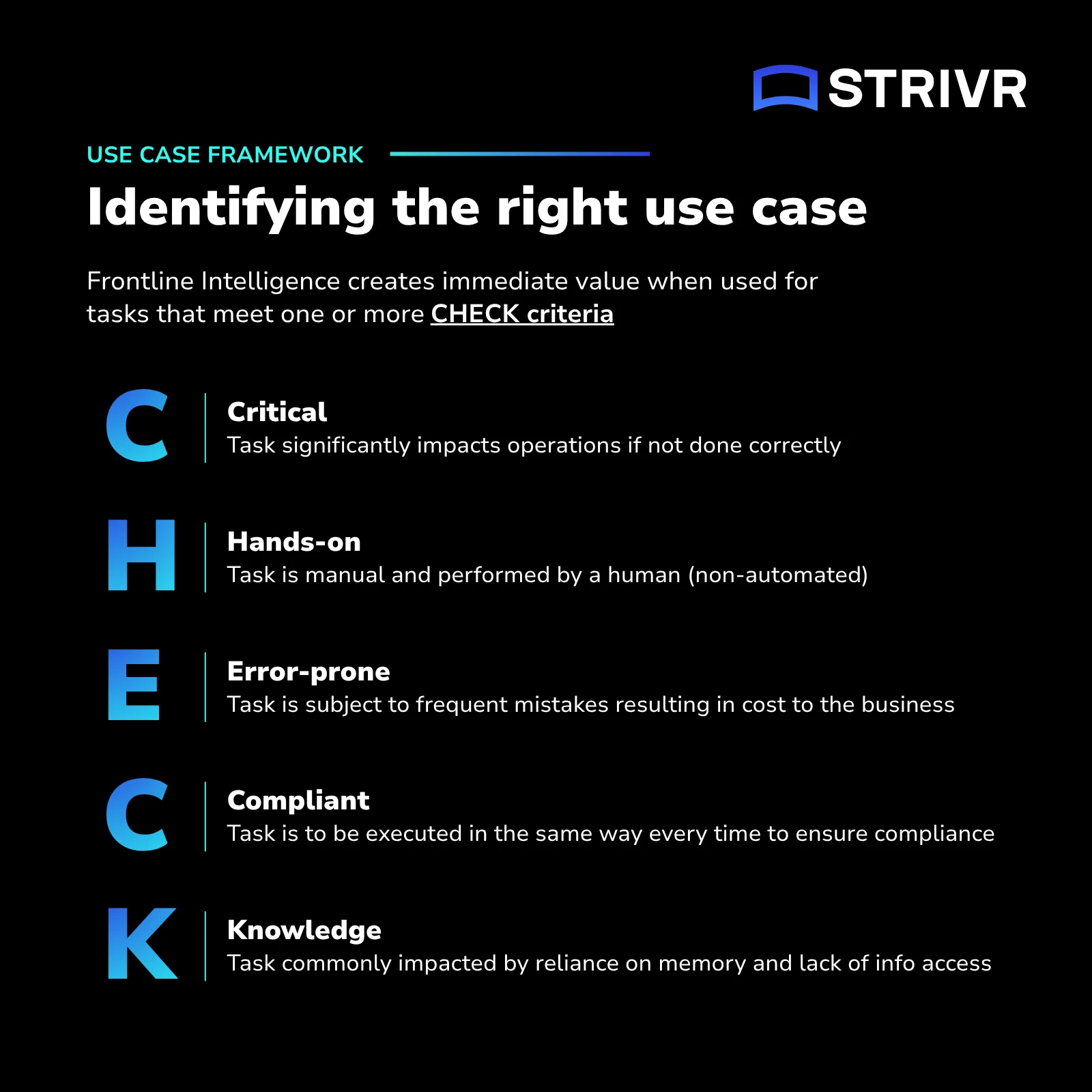
At Strivr, we use the CHECK framework to identify high-impact frontline use cases where Frontline Intelligence can create immediate operational value. The more CHECK criteria a workflow meets, the stronger the opportunity for VLM-powered error detection and correction, which can lead to more consistent and productive operations.
Advances in computer vision and AI now make this practical in a way earlier workforce technologies often could not. Instead of simply displaying information, systems can understand work as it happens, detect execution issues in context, and guide workers in real time.
This shift moves the conversation beyond hardware and toward measurable frontline execution outcomes.
VLMs are the AI layer that makes Frontline Intelligence possible. They help the system visually understand work as it happens. This visual understanding can then support real-time detection, correction, and guidance at the point of work.
For Strivr, the shift is that knowledge shouldn’t stay trapped in documents, training sessions, or informal conversations. It should show up during execution as guidance workers can act on in the moment.
Frontline Intelligence applies VLMs to real operating environments so workers can be supported without leaving the task. Through smart glasses and audio-based queues, workers can receive guidance while staying focused on the work in front of them. If the VLM detects an error, missing step, or out-of-sequence action, the system can alert the worker and help guide the correction in real time.
This isn’t about replacing workers. It’s about reducing the amount of work that depends on memory alone.
When VLMs are applied this way, they can help organizations:
In other words, VLMs help turn existing operational knowledge into support that shows up when work is happening. This is the foundation of mistake-free work.
Visual Language Models matter because frontline work is visual, physical, and context-dependent.
They give AI a way to understand what’s happening during execution, not just analyze what happened after the fact. For operations leaders, this creates a new opportunity to make frontline support more timely, specific, and useful.
Knowledge already exists inside organizations. The next step is turning that knowledge into guidance that can show up automatically when workers need it.
This is Frontline Intelligence, helping workers get the right support in real time so work can be done more consistently, safely, and correctly.
Strivr helps organizations turn existing operational knowledge into hands-free, context-aware AI guidance that supports workers in the flow of work.
Talk to our team about how Frontline Intelligence can support mistake-free execution.

.jpg)
.webp)
.webp)
Receive a free VR headset and experience the Strivr platform for yourself.


