Closing the heavy equipment maintenance knowledge gap
4
min read


When one of your machines is down, your technician may know what needs fixing but still need the right information to move forward. Which panel comes off first? Where is the component? Which procedure applies to this machine?
For heavy civil and infrastructure contractors maintaining their own fleets, those delays affect both the shop and the jobsite. Finding an answer can mean putting down tools, getting out from under equipment, searching a manual, or calling someone who is already helping another crew.
Evaluating AI for heavy equipment maintenance starts with those moments. Equipment and maintenance leaders should assess whether the system provides relevant, trustworthy guidance where technicians need it, fits the physical work, and delivers a measurable improvement.
These seven questions can help you define that evaluation.
A useful AI initiative starts with a specific operational problem.
For equipment maintenance, the opportunity might be a recurring repair that often requires expert support, a diagnostic process where technicians spend too much time locating information, or an equipment family responsible for a meaningful share of downtime.
The strongest starting point has enough frequency and operational impact to matter while remaining focused enough to evaluate clearly. “Improve maintenance with AI” is difficult to test. Helping technicians access the correct troubleshooting information for a defined maintenance workflow gives the organization something concrete to design around and measure.
Starting with the problem also keeps the business case tied to outcomes. Emergence Capital has described this principle in its work with Bedrock Robotics, emphasizing the importance of building around delivered outcomes rather than the underlying technology. The application is different, but the lesson carries over to maintenance. The value of an AI pilot should be defined by what improves in the operation.
Once you have identified the maintenance task, look at what actually happens when your technician performs it.
Where do they stop? What do they search for? Who do they call? Which systems do they move between? How long do they wait for an answer?
The delay may begin before the technician even reaches the component. A technician may know that a hydraulic return oil filter needs replacing but still need to determine which access panel to remove first, what else needs to come off, and which procedure applies to that machine.
Finding the correct access information can help avoid unnecessary removal steps and repeated trips to look something up. Bobcat, for example, highlights access to engine components and routine maintenance items as an important factor in reducing service time.
Other delays can begin with incomplete information. A work order that simply says “needs tire” may still require several calls to determine which tire, what the issue is, and what needs to happen next.
These moments help reveal where AI guidance could create value. If your technicians are losing time finding trusted information, the evaluation should look at whether that information can reach them faster.
If the real constraint is parts availability, scheduling, or another operational issue, that points to a different problem to solve.
Equipment maintenance rarely depends on one source of information.
Your technicians may need OEM manuals, company procedures, maintenance history, equipment-specific records, internal terminology, and practical knowledge from experienced employees.
Equipment leaders should understand which information sources the system can access, how those sources are approved and updated, and whether the guidance reflects the equipment and maintenance practices your team actually uses.
Caterpillar’s SIS2GO resources illustrate the types of information technicians may need at the machine, including fault-code troubleshooting, repair procedures, hydraulic schematics, and fluid and filter locations.
An AI evaluation should establish which relevant sources the system can access and how guidance stays current.
This is central to Frontline Intelligence. Useful guidance depends on trusted information that is relevant to the machine, the maintenance task, company procedures, previous maintenance activity, and what the technician is trying to accomplish.
Heavy-equipment maintenance is physical.
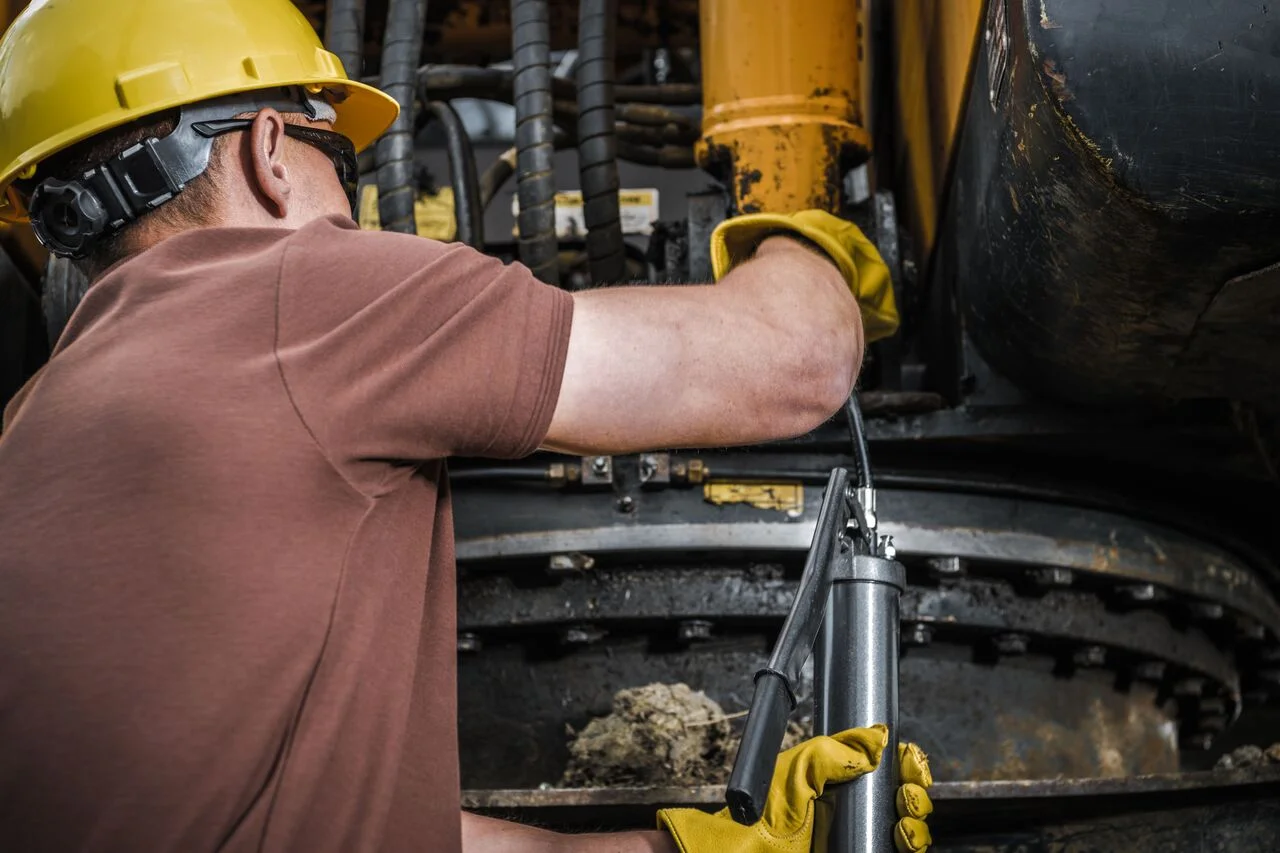
A technician may be under equipment, reaching into a tight compartment, or using both hands to complete a repair. Looking up an answer can require putting down tools, getting out of position, and finding a phone or laptop before returning to the task.
Evaluate the experience where the work actually happens.
Can your technician ask a question and hear useful guidance without holding another device? Can they repeat an instruction or reach the relevant step without navigating through information they already know? Does the experience still work with the noise, protective equipment, and connectivity conditions your team encounters?
Strivr provides hands-free access to maintenance guidance through supported smart glasses, allowing technicians to access information while remaining focused on the equipment.
The practical test is straightforward: Does getting an answer help the repair move forward, or create another interruption?
AI guidance should have clear boundaries inside a maintenance task.
Some questions can be supported using approved information, while unfamiliar conditions, higher-risk situations, or complex problems may still require an experienced technician or subject-matter expert.
Before launching a pilot, your team should define when AI guidance can support the technician and when the situation should be escalated. Experienced technicians and maintenance leaders remain essential when conditions fall outside what the system is designed to support or require deeper judgment.
The National Institute of Standards and Technology’s AI Risk Management Framework recommends defining responsibilities for human oversight and evaluating AI under conditions similar to its intended deployment. For maintenance teams, that means testing both the guidance and the process for handling questions the system cannot answer reliably.
Governance should also be part of your evaluation.
Ask:
Current and future capabilities should remain clear as well. Trusted, hands-free guidance can address an immediate information-access problem today. Over time, richer visual and work context can support more proactive assistance and stronger execution validation.
Clear boundaries help your team understand what the technology is expected to support and where human expertise remains essential.
Define success before the pilot begins.
For a component-access task, you might measure how long it takes your technician to find the correct procedure, identify the required access steps, and reach the component. You can also record interruptions to retrieve information and calls needed to clarify routine instructions.
Compare those measures with a baseline from similar work.
Where the pilot supports it, look at broader outcomes such as:
Keep the measures tied to what the technology can actually influence. A repair may still be delayed by parts availability, scheduling, approvals, or other factors unrelated to information access.
Routine requests for information should also be evaluated separately from appropriate expert escalation. The goal is to help technicians get the support they need while using your experienced colleagues’ time where their judgment creates the most value.
For Frontline Intelligence, that means asking whether technicians reached relevant information faster, reduced unnecessary searching or escalation, and ultimately reduced equipment downtime for the business.
That is where the ROI becomes real. Time saved during diagnosis and repair can help get equipment back to work sooner, reducing the cost of downtime.
You don't need to start across your entire maintenance operation.
Choose one recurring maintenance task, one equipment family, and a small technician group. Define the information technicians will need, the conditions in which they will use the system, and the result you want to measure.
Then use the pilot to determine what should happen next.
Did technicians get the information they needed faster? Did the experience fit the way they actually work? Did the guidance remain grounded in trusted sources? Were the governance and escalation processes appropriate? Did the result justify continuing?
From there, you can decide whether to expand, refine the approach, or stop.
A focused pilot gives you evidence to make that decision before committing to a broader deployment.
These seven questions come back to one starting point: What maintenance problem are you trying to solve?
Identify where your technicians lose time, what knowledge they need, and how AI can deliver trusted guidance without interrupting the work. Just as important, determine where human judgment remains essential and how you'll measure success.
Frontline Intelligence brings company-approved maintenance knowledge directly to technicians through hands-free AI guidance, helping them diagnose issues and move repairs forward without searching through manuals or waiting for expert support.
Start with a specific maintenance task where better access to knowledge can make a measurable difference. If technicians can diagnose and resolve issues faster, the impact should be reflected in reduced equipment downtime and the costs associated with it.
Explore how Strivr can help your technicians get the guidance they need, when they need it, to complete repairs faster and get critical equipment back to work.



Receive a free VR headset and experience the Strivr platform for yourself.


